
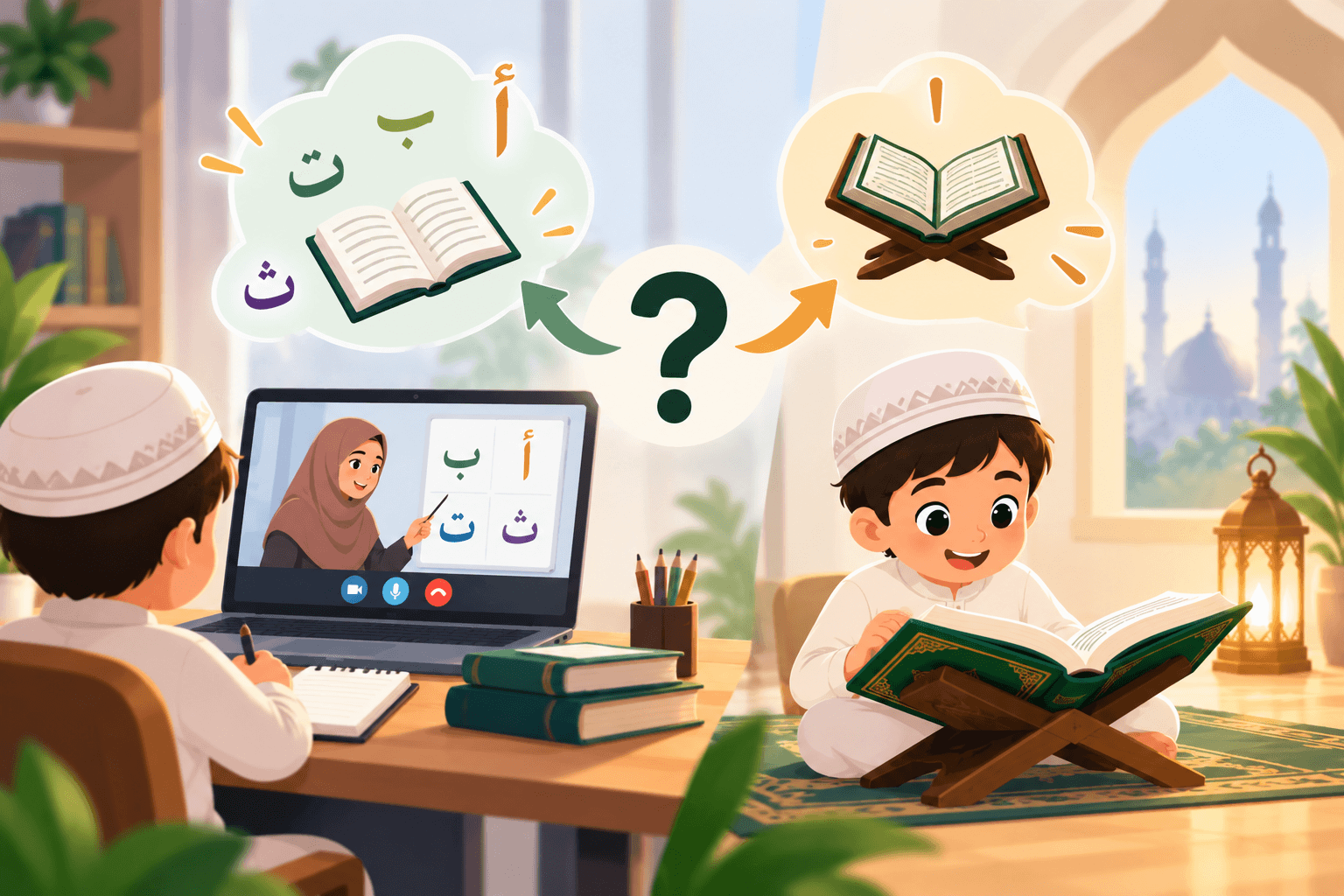
This question trips up a lot of parents early on, and it's a reasonable source of confusion: Arabic is the language of the Quran, so it feels logical to assume a child needs to learn the language first, the way you'd learn French before reading a French novel. But Quran reading and Arabic language fluency are actually two distinct skills, learned somewhat differently and understanding that difference will save you from unnecessary delay in starting your child's Quran education.
The Short Answer
No, a child does not need to learn Arabic as a language before starting to read the Quran. Learning to read the Quran (Nazra) teaches letter recognition, pronunciation, and Tajweed rules essentially, how to accurately sound out and recite the text. This is different from Arabic language fluency, which involves understanding vocabulary, grammar, and meaning. A child can become a fluent, accurate Quran reader without understanding a single word they're reading, and many lifelong reciters have exactly this skillset without ever formally studying Arabic as a language.
Why This Confusion Happens
The confusion is understandable because of how English-language learning typically works you learn a language before reading its literature. Quran reading instruction works differently, closer to learning to read phonetically in any language through sound-letter association, rather than needing to first understand vocabulary and grammar. This is actually how Quran reading has traditionally been taught for centuries, including to native Arabic speakers who themselves may not fully understand classical Quranic Arabic without additional study.
What Nazra Quran Actually Teaches
Our Nazra-e-Quran program focuses specifically on accurate reading Arabic letter recognition, correct pronunciation (Makhaarij), and Tajweed rules governing elongation, pauses, and letter combinations. None of this requires understanding what the words mean; it requires accurately reproducing the sounds and rhythm of the text as written. This is why young children, including those with zero prior Arabic exposure, can begin this stage of learning immediately.
So What Does Arabic Language Study Actually Add?
This is where it gets genuinely useful to understand the distinction. While Arabic fluency isn't required to read the Quran accurately, it adds real value in a different way: understanding what you're reciting. A student who's completed Nazra can read any page of the Quran fluently, but without Arabic language study, they're reciting words without necessarily grasping their meaning.
Our Arabic Language program is built around this gap specifically helping students move from accurate recitation to genuine comprehension, covering both classical Quranic Arabic vocabulary and grammatical structure.
Should They Be Learned Together, or Separately?
There's no single correct order here, and it depends on your goals and your child's age and interest level:
Nazra First, Arabic Later
The most common approach, and often the most practical for younger children. Starting with reading fluency gives an immediate, tangible skill, and Arabic language study can be introduced once that foundation is solid often most engaging for a slightly older child who can better appreciate the “why” behind grammar and vocabulary.
Learning Them in Parallel
Works well for some families, particularly with older children or teenagers who have the attention span and motivation to handle two distinct but related subjects at once. This isn't inherently better or worse it depends on what the individual child can realistically sustain without burnout.
Arabic First, in Rare Cases
Some families with a strong interest in deep, early comprehension choose this, though it's less common, since it delays what's often the more immediately motivating skill (actually being able to recite) in favor of foundational language study first.
Does Skipping Arabic Study Limit a Child Long-Term?
Not in terms of their ability to read and recite the Quran that skill is complete on its own through Nazra instruction alone. What it does limit is depth of understanding of the text's meaning, which is a separate, valid, and valuable pursuit, but genuinely optional depending on a family's specific goals. Many practicing Muslims read and recite Quran fluently their entire lives without formal Arabic language study, and this is a complete, legitimate form of engagement with the text — not an incomplete version of something else.
Does Arabic Help With Hifz (Memorization)?
This is a reasonable related question, and the honest answer is: it can help, but it's not required. Some Huffaz (those who've memorized the Quran) report that understanding word meanings helps with retention, since meaning provides an additional memory anchor beyond pure sound repetition. Others successfully memorize through pure repetition and Tajweed accuracy alone, without parallel Arabic study. If your child is progressing toward Hifz, Arabic study alongside it is a reasonable enhancement to consider, but its absence isn't a barrier to successful memorization.
For most families, particularly with younger children, the most common and practical path is: start with Nazra to build reading fluency and a habit of daily engagement with the Quran, then introduce Arabic language study once that foundation is comfortable whether that's after a few months or a couple of years, depending on the child's pace and interest. This sequencing avoids overwhelming a young child with two distinct subjects simultaneously while still keeping the door open for deeper comprehension down the line.
If you're unsure which sequence fits your specific child, our tutors can help assess this directly based on age, current level, and family goals you can learn more about their approach on the Meet the Tutors page.
Related Reading
If you're also weighing memorization goals alongside this decision, our guide on Nazra Quran vs Hifz Quran covers that related distinction, and our guide on the best age to start Quran classes covers broader readiness questions that often come up around the same time as this one.
Making the Decision for Your Family
There's no universal right answer on sequencing — only the answer that fits your child's age, attention span, and your family's specific goals for their Islamic education. If you're still deciding, a free trial class can help clarify where your child currently stands and what a realistic starting sequence looks like.
FAQ
Can a child learn to read the Quran without understanding Arabic as a language?
Yes — reading the Quran (Nazra) requires accurate pronunciation and Tajweed, not language comprehension. A child can become a fluent, accurate reader without understanding the meaning of the words.
Does learning Arabic make Quran reading easier?
It can help with retention and understanding, particularly for memorization, but it's not required to read or recite the Quran accurately many fluent reciters never formally study Arabic as a separate subject.
What age should a child start Arabic language study, if at all?
There's no fixed age requirement, since it's not a prerequisite for Quran reading. Many families introduce it once Nazra reading fluency is established, often a year or more after starting formal Quran lessons.
Is it better to learn Arabic and Quran reading at the same time, or one after the other?
Both approaches work; starting with Nazra first and introducing Arabic later tends to be more manageable for younger children, while older children or teens may handle learning both simultaneously well.
Will my child understand what they're reciting if they only complete Nazra and skip Arabic study?
Not necessarily in terms of word-by-word meaning, though many students develop some contextual understanding over time through repeated exposure, translation resources, and general Islamic education covering the content of what's being recited.