
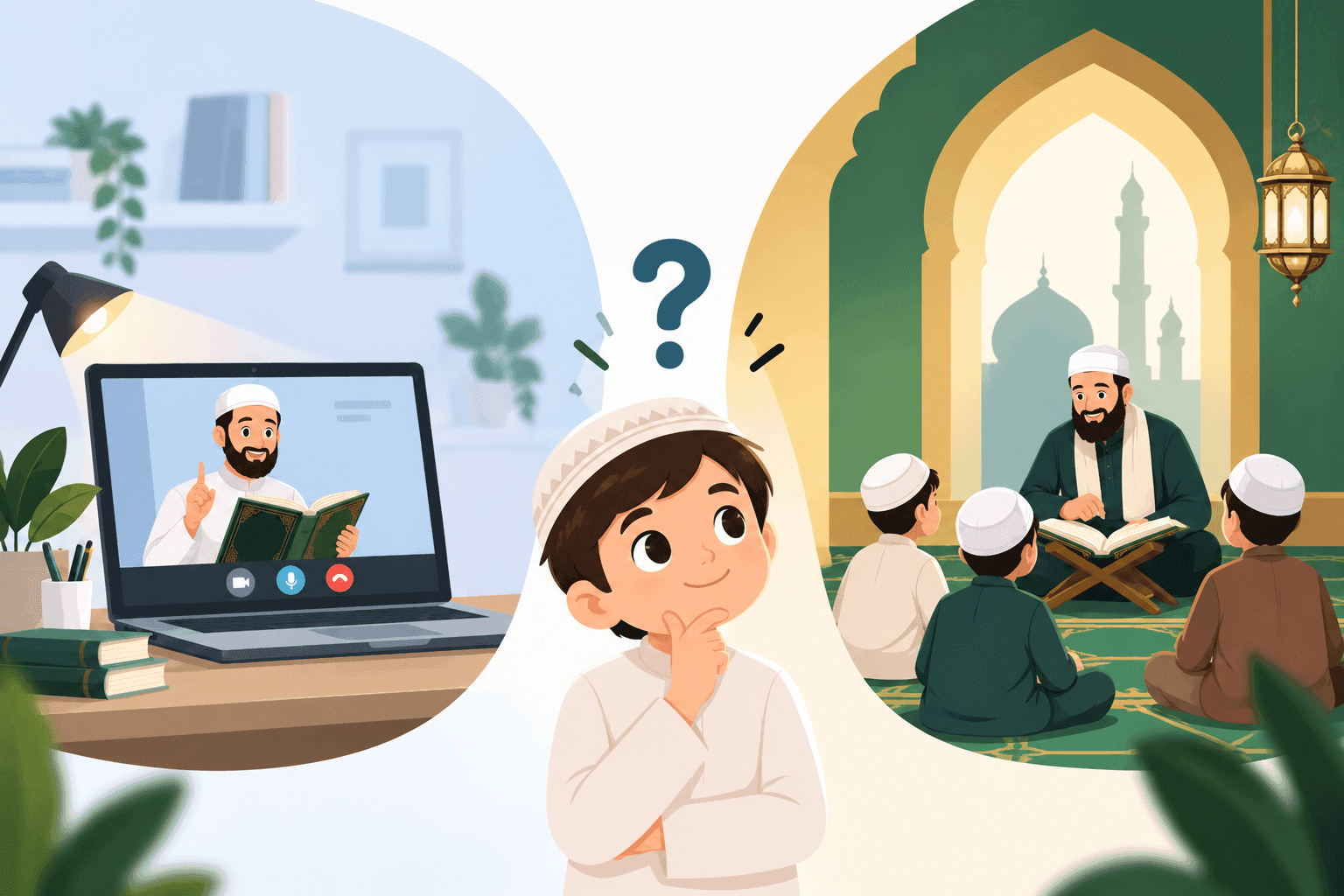
Online Quran Classes vs Local Mosque Classes: Which Is Right for Your Child?
For Muslim families living in the US, UK, Canada, and Australia, this decision usually comes up sooner or later: should your child learn Quran at the local mosque, or through an online tutor?
Both can work well but they work well for different families, in different circumstances. There isn't a universally “better” option, only a better fit for your specific situation.
This guide breaks down the real differences across the factors that actually matter to parents not just convenience, but teaching quality, cost, consistency, and long-term results.
The Honest Starting Point
Before comparing details, it's worth being upfront about something: a good mosque program with an experienced, attentive teacher can absolutely produce excellent results just as a good online Quran tutor can. The quality of instruction usually matters more than the format itself. What follows isn't an argument that one is inherently superior, but a practical breakdown of the trade-offs each option actually involves for a diaspora family's daily life.
Comparing the Two: What Actually Differs
Travel Time and Logistics
This is often the most underestimated factor. A local mosque class might run for 45 minutes to an hour, but by the time you account for driving, drop-off, waiting around or driving back and forth twice, and pick-up, many families lose 1.5–2 hours per session just in logistics multiplied across two or three sessions a week. With online Quran classes, that time returns to your family entirely. For working parents, or families with multiple children in different activities, this alone often tips the decision.
Class Size and Individual Attention
Most mosque Quran classes, especially in areas with a large Muslim population, run as group sessions sometimes with ten, fifteen, or more children per teacher. In that setting, a child who's falling behind can go unnoticed for weeks, and a child who's ahead can get bored waiting for the group to catch up. One-on-one online tutoring solves this structurally, not just in theory. Every minute of the session is focused entirely on your child's specific level, whether that's through our Nazra-e-Quran program, Hifzul Quran program, or Arabic Language program. There's no “waiting for the group” — pacing adjusts to one student, in real time.
Consistency of Teacher and Curriculum
Mosque programs, particularly volunteer-run ones, can have teacher turnover a well-loved teacher moves, a volunteer's availability changes, and the class is handed to someone new mid-year. This disrupts a child's learning rhythm and can quietly set progress back by months. With a dedicated online tutor, your child works with the same teacher consistently, building a specific rapport and a curriculum that's actually tracked from where they left off, not restarted with a new instructor's approach. You can review our Meet the Tutors page to see who your child would actually be learning from before committing.
Scheduling Flexibility
Mosque class timings are usually fixed a specific evening, a specific hour, take it or leave it. If your child has a school event, a sports commitment, or you're traveling, that week's class is simply missed, with no easy way to make it up. Online tutoring, especially with a private tutor, tends to offer far more flexibility to reschedule around your family's actual life, rather than the other way around.
Safety and Supervision
This is a genuinely important consideration for many parents, and it cuts both ways. A mosque environment offers in-person supervision and a physical community setting some children thrive in. Online classes, when done through a structured platform with recorded sessions (as ours are), give parents the ability to review every single class after the fact something that's rarely possible with a physical class you're not sitting in on. Neither format is inherently safer; the actual safeguard is the platform or institution's own accountability structure, not whether the class happens to be online or in-person.
Cost
Mosque classes are frequently free or low-cost, funded by the community which is a real advantage worth acknowledging honestly. Online 1-on-1 tutoring is a paid service, since it involves dedicated, individual teacher time rather than one teacher split across many students. For families where cost is the primary constraint, a well-run mosque program is a legitimate and valuable option. Where online tutoring tends to justify its cost is in outcomes per hour because the attention is individual rather than shared, progress per session is often faster, which can offset the per-session cost difference over time.
When Local Mosque Classes Might Be the Better Fit
- Your child thrives in group, in-person social settings
- Cost is a significant constraint for your family right now
- You have a specific mosque program with a teacher you already trust and know well
- Your child benefits from the physical community and peer environment a mosque provides
When Online Classes Might Be the Better Fit
- Your family's schedule doesn't align well with fixed mosque timings
- Your child needs individual pacing either because they're struggling or because they're advanced and getting bored in a group
- You live somewhere without a strong local Islamic education option nearby
- You want the ability to review recorded sessions and track progress directly
- Consistency of teacher and curriculum matters more to you than in-person social setting
A Middle Path Many Families Use
It's worth mentioning that these two options aren't always mutually exclusive. Some families use mosque classes for the community and social aspect of Islamic learning, while using a dedicated online tutor for structured, individual progress in reading, Tajweed, or memorization — treating the two as complementary rather than competing. If you're exploring this approach, our Mission & Vision page explains how we think about supporting a child's overall Islamic education, not just one isolated subject.
What Other Parents Found
If you're still weighing this decision, it can help to hear from families who've been through it. Our Student Stories page includes real experiences from parents in the US, UK, and Canada who made this same choice including a few who started with mosque classes and later added online tutoring once they noticed their child needed more individual attention.
There's no universally correct answer here only the answer that fits your child's personality, your family's schedule, and what you're able to commit to consistently.
Related Reading
This post pairs well with our earlier guides on how many hours a day kids should study Quran and what to do if your child starts losing interest — both are useful whichever format you end up choosing.
Still Deciding?
If you're unsure which direction makes sense for your family, a free trial class can help you see firsthand how one-on-one online teaching works, without any pressure to commit before you're ready.
FAQ
Is online Quran learning as effective as learning at a local mosque?
When taught by a qualified, experienced tutor, online Quran classes can be just as effective and in some cases more effective for individual pacing since attention is focused entirely on one student rather than shared across a group.
Is it safe for a child to learn Quran online?
Yes, provided the platform has proper structure and accountability recorded sessions, verified tutor credentials, and parent visibility into progress are good indicators of a safe, well-run online program.
Can I combine mosque classes with online tutoring?
Yes, many families do exactly this using mosque classes for community and social connection, and online tutoring for focused, individual academic progress.
Why do online Quran classes cost more than mosque classes?
Online 1-on-1 tutoring involves a dedicated teacher's individual time for one student, rather than one teacher's time shared across many students, which is typically reflected in the cost difference.
What if my child has already started at a mosque and wants to switch to online classes?
This is a common transition, and a good online tutor will assess your child's current level in the first session to continue from where they left off, rather than starting over from the beginning.